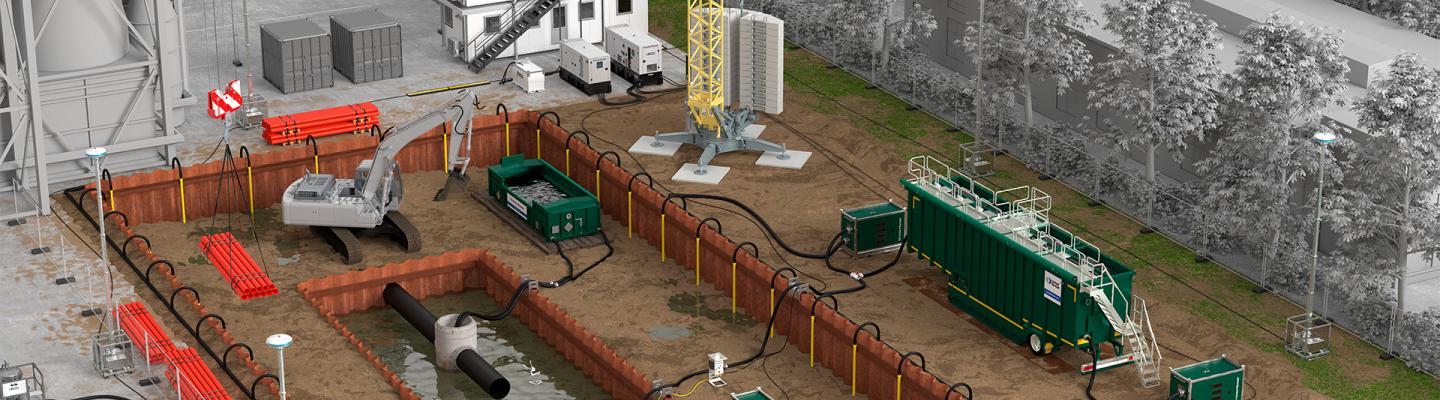
When you need temporary power or a backup power supply, learning about the different options available can help you make the right choice.
Whether your project is in the middle of a city or gaining access to temporary power for your construction site is an early critical step. Electrical demands can quickly grow as light towers, cranes and other equipment is added.
The question of how to get temporary power for construction projects before a connection to the power grid is established has many possible answers. Unless you can spend the time and money to install temporary utility most of those answers involve generators, which are the most common solution. However, alternative energy sources are sometimes an option, as are battery packs.
If you’re at the point in a project where the jobsite is connected to the grid and the power goes out, you may also need generator backup to help keep your project on schedule.
3 types of temporary power supplies: industrial, towable and portable
The size, location, and stage of the project will dictate your generator needs. Small to medium projects may require a mix of portable and towable generators to power trailers, power tools and the like, while larger, energy-intensive sites such as high-rise towers or mining installations may require the output of industrial generators.
Maximum power needed? Choose industrial generators
Industrial generators offer far greater capacity than towable generators and are suitable for powering an entire large construction site or a mining operation. A semitrailer truck may be required for delivery.
Models include this 200 0kW mobile industrial generator, capable of running nearly 10 hours at maximum load on a single 4,750 litre tank of diesel, as well as giants capable of outputting over a megawatt at 75% load for nearly 24 hours.
Due to their large fuel demands, industrial generatorsare often paired with high-capacity portable fuel tanks.
In Need of lots of power and mobility? Pick a towable generator
Towable generators, convenient for larger or longer-term jobs, can be hitched to any truck and moved where needed throughout a jobsite. Some rental units come already mounted on highway-legal trailers. In addition to having multiple outlets and voltage controls, many towable generators feature large fuel tanks, which enable longer continuous operation.
Models range from the small and nimble, such as this 15.2-23.2 kW generator, to 300 kW towable generators.
If you are working in an area with noise limits, look for a model with sound attenuation for quieter operation. Two-wheeled trailers work better on uneven terrain than four-wheeled, so choose carefully depending on the jobsite terrain.
Flexible power generator? Choose the Portable power generators
Portable generators are an ideal temporary power supply for construction sites in need of a versatile solution that is easily moved from one spot to the next. Power output typically corresponds with size.
This rugged 2.9 kW inverter generator, easily carried by one or two people, can run for up to five hours on a tank of gas and is ideal for powering tools such as compressors, grinders and fusion welders. Larger portable generators, such as this 5.4 kW inverter model, come mounted on a wheeled cart and can provide power for multiple tools, equipment or light towers or act as a backup power supply in the event of a power outage.
Never without power? Pick a generator backup
In addition to providing a temporary power supply for construction site needs, generators and battery packs also double as backup power sources in the event of a power outage once the site is connected to the grid.
What is the best backup source for a power outage? That depends on your power needs.
To figure out what your jobsite requires to weather an outage, identify the equipment critical to keeping the project running. If you plan to rely on generators for a power outage, use this step-by-step formula for generator sizing to help you determine the best units to have on hand. Add an additional 10% of capacity as a safety margin.
Generators can be a convenience or a critical asset when you lack access to grid power. They can be complex and you should always consult with an expert regarding the specific circumstances, applicable rules and regulations related to your site and to your situation.
 Facebook
 Linkedin
 Twitter
 Email
 Print
 Copy Link
 RSS Feed