Looks like you're in [country-name]. Switch to the [site-name] for local equipment and services?

Go to [site-name]
Stay here

User account menu

  • 844.873.4948
  • English

    Australasia

    • Australia

    Europe

    • Français
    • Deutsch
    • English
    • Nederlands

    North America

    • English
    • Español
    • Français
  • Sign In / Register
United Rentals Home
  • Rent
    • All Equipment
    • Popular Rentals
    • Scissor Lifts
    • Boom Lifts
    • Telehandlers
    • Mini Excavators
    • Skid Steers & Track Loaders
    • Rental Resources
    • Rental Protection Plan (RPP)
    • Why Rent with United Rentals
  • Buy
    • All Used Equipment
    • Popular Used Equipment
    • Buy Forklifts
    • Buy Scissor Lifts
    • Buy Boom Lifts
    • Buy Mini Excavators
    • Buy Compressors
    • Buying Resources
    • Financing
    • United Guard™
  • Total Control
    • Account Dashboard
    • Invoices & Payments
    • Items On Rent
    • UR Mobile App
    • About Total Control®
  • Invoices & Payments
    • Invoices
    • Lien releases
    • Apply for credit
  • Locations
    • Find a Location
  • Training
    • Course Catalog
    • Training Credentials
    • United Academy
    • About United Academy
    • Care & Support
    • United Academy - Course Catalog
  • Solutions
    • Worksite Performance Solutions™
    • Specialty Solutions
      • Commercial Trucks
      • Flooring & Facility Solutions
      • Power & HVAC
      • Climate Solutions
      • Fluid Solutions
      • Trench Safety
      • Reliable Onsite Services
      • Tool Solutions
      • Storage Containers & Mobile Offices
      • Communications
      • Industrial Blinds
    • Power & HVAC
    • Climate Solutions
    • Fluid Solutions
    • Trench Safety
    • Trench Engineered Systems
    • Reliable Onsite Services
    • Tool Solutions
    • Storage Containers & Mobile Offices
    • Temporary Industrial Tents
    • Commercial Trucks
    • Flooring & Facility Solutions
    • Ground Protection Matting Solutions
    • Industry Solutions
      • Energy & Utility
      • Chemical
      • Oil & Gas Refining
      • Oilfield Services
      • Civil and Infrastructure
      • Restoration and Remediation
      • Government Solutions
      • Agriculture
    • Energy & Utility
    • Data Centers
    • Renewable Energy
    • Chemical
    • Oil & Gas Refining
    • Oilfield Services
    • Restoration & Remediation
    • Civil & Infrastructure
    • Government Solutions
    • Events & Entertainment
    • Emergency Solutions
    • Emergency Response
  • Services
    • Digital Solutions
    • Total Control®
    • Mobile App
    • Notifications
    • Benchmarking
    • Wedge
    • Downloadable Catalogs
    • Repair & Maintenance Services
    • Owned Equipment Service
    • Rental Equipment Service
    • Training Services
    • United Academy
  • Safety
    • Safety Training
    • Safety Articles
  • Company
    • Resource Center
    • Events
      • Events Calendar
      • Webinar Series
    • In the News
    • Press Releases
    • Investor Relations
      • Annual Report
      • Reports & Proxy Statements
      • Corporate Governance
      • Investor Press Releases
      • Investor Events, Calls & Presentations
      • Research Coverage
      • SEC Filings
    • Careers
      • Search Careers
      • Career Areas
    • Who We Are
    • About Us
      • About Us
      • Our Culture
      • Board of Directors
      • Corporate Leadership
      • Sponsorships & Partnerships
      • Awards & Recognition
      • Corporate Responsibility Report
      • Small Businesses
    • Safety
    • Sustainability
    • Productivity
    • Innovation
  • Resource Center
  • Equipment
  • Data
  • Safety
  • Expertise
  • All Categories
Pump

Types of Pumps: A Guide to the Basics

Use this quick guide to understand the basic differences between the most common pump types.

February 27, 2024
  • How to Use

Article Updated on: November 10, 2026

When you need to transfer any type of fluid from one location to the other, your choice of pump will have a big impact on how efficiently and effectively you get the job done. Here’s a look at the most common types of pumps and what they’re used for.


What are the most common types of pumps?

The main types of pumps are centrifugal pumps and positive displacement pumps. Centrifugal pumps use a rotating impeller to move fluid and work best for high-volume, low-viscosity applications. Positive displacement pumps use pistons or diaphragms to move a fixed volume of fluid and work best for high-viscosity or high-pressure applications. Common subtypes include trash pumps, vacuum assisted pumps, wellpoint pumps, diaphragm pumps and submersible pumps.


What are centrifugal and positive displacement pumps?

Pumps are often categorized into two broad types: Centrifugal and positive displacement.

A centrifugal pump uses the energy created by an engine- or motor-powered rotating impeller to move fluid. These pumps work in the following way:

  1. Fluid enters the pump suction, then the impeller eye
  2. As the impeller rotates, the fluid is moved either outward or upward, depending on the type of pump (radial or axial), increasing its velocity
  3. The fluid then enters a diffuser or volute, where it gains pressure, and is pushed out through the discharge point

A centrifugal pump may have one impeller (single stage), two impellers (two stage) or three or more impellers.

A positive displacement pump uses suction to draw fluid into an intake chamber, then uses the mechanical power of a plunger or piston to force it into a discharge chamber and through the discharge point.

Feature

Centrifugal Pump

Positive Displacement Pump

Best used for

High-volume, low-viscosity fluids

High-viscosity fluids (ex. oils or glycerin)

Flow consistency

Varies with pressure

Steady regardless of pressure changes

Maintenance

Minimal; fewer moving parts

More frequent; higher operating costs

Priming required

Yes, must be primed before startup

No

Common types of pumps

Trash pump, vacuum assisted pump and rotary wellpoint pump

Diaphragm pump and wellpoint piston dewatering pump

Operating speed

Faster

Slightly slower

Risk if run dry

Overheating or vibration

Pump failure

What are the types and advantages of centrifugal pumps?

Even at a small size, centrifugal pumps can move a lot of water fast. Another advantage: Because they don’t have a lot of moving parts, they require minimal maintenance.

The downsides: Centrifugal pumps can’t operate unless they have fluid in the system, so they must be primed before they are started. In addition, if there is no liquid to run through the pump, if too much air gets suctioned into the system or if gas bubbles form while the pump is operating, the pump can overheat or vibrate, which could lead to a pump breakdown.

Centrifugal pumps come in many types, each of which is suited to different applications. Below are some of the most widely used centrifugal pumps.

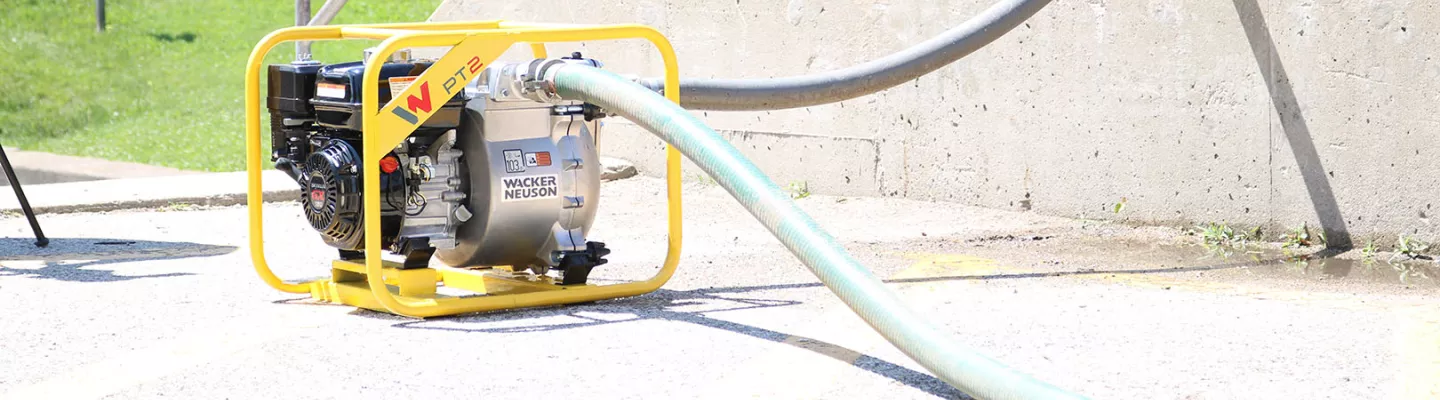
Trash pumps

Trash pumps are good at handling wastewater and fluids that contain debris, such as stones, leaves, sticks and mud, that can clog other pumps. Trash pumps are often used for dewatering and for removing clogs and solids from liquids.

Vacuum assisted pumps

Vacuum assisted pumps make priming a centrifugal pump easier. The vacuum removes air from the pump and brings liquid into it so the pump can be started. Depending on the suction and discharge size, these pumps may be well suited to pumping graywater, muddy water, sludge and sewage.

Rotary wellpoint pumps

Designed specifically for wellpoint and sock dewatering, rotary wellpoint dewatering pumps are efficient at handling high air and water volumes.

What are the types and advantages of positive displacement pumps?

Positive displacement pumps are better than centrifugal pumps at handling high viscosity fluids, such as oils and glycerin. They are often used in wastewater treatment. These pumps maintain a steady flow, even when the pressure of the fluid changes. They are also more energy efficient than centrifugal pumps.

On the downside, positive displacement pumps operate at a slightly slower speed than centrifugal pumps and require more maintenance. That can make them more costly to operate. Running them dry can cause pump failure.

There are many types of positive displacement pumps. Two of the most common types are diaphragm pumps and wellpoint piston dewatering pumps.

Diaphragm pumps

Diaphragm and double-diaphragm pumps propel liquids through their system with the use of one or two reciprocating diaphragms. They can run on condensed air, electricity or diesel. Depending on the material they’re made from, diaphragm pumps can handle liquids ranging from water to acids. They are often used for industrial, chemical and fuel transfer.

Wellpoint piston dewatering pumps

Like rotary wellpoint pumps, wellpoint piston pumps offer high suction lift and high air-handling capabilities. They are efficient and cost-effective for dewatering operations.

What are submersible pumps?

Some centrifugal pumps and positive displacement pumps are designed to be fully submerged in water. The motor of a submersible pump is located in a hermetically sealed compartment that keeps liquids out. Because the pump is submerged, there is no suction lift limitation and no need for a suction lift hose.

Submersible pumps are often used for household flood dewatering, emptying wells and ponds, and pumping sewage. They are quiet and efficient.

Choose the right pump with United Rentals

Today’s pump technology includes many variations on these basic pump types. If you’re not sure what type of pump will work best for your application, talk with pump experts at your rental vendor, like representatives from United Rentals’ Fluid Solutions team. Choosing the right pump is key to getting the job done the first time.


Frequently asked questions

What are the main types of pumps used on a jobsite?

The two main types of pumps are centrifugal and positive displacement pumps. Centrifugal pumps use a rotating impeller to move high volumes of fluid efficiently, while positive displacement pumps use a piston or diaphragm to move fluid at a steady rate, making them better suited for high-viscosity applications.

What types of pumps are best for dewatering?

Trash pumps, vacuum assisted pumps and rotary wellpoint pumps are among the most common types of pumps used for dewatering. Each is designed to handle a different mix of debris, air volume and water volume on the jobsite.

What types of pumps handle high-viscosity fluids?

Positive displacement pumps, including diaphragm pumps and wellpoint piston dewatering pumps, are better suited than centrifugal pumps for handling high-viscosity fluids such as oils and glycerin.

What is a submersible pump, and how does it differ from other types of pumps?

A submersible pump is a centrifugal or positive displacement pump designed to operate fully underwater. Its motor sits in a hermetically sealed compartment, eliminating the suction lift limitation found in other types of pumps. Submersible pumps are often used for flood dewatering, well and pond emptying and sewage pumping.

Browse our pump selection or contact the United Rentals Fluid Solutions team for help with all your pump and filtration needs.

  • Facebook Facebook
  • X X
  • Linkedin Linkedin
  • Email Email
  • Print Print
  • Copy Link Copy Link
  • RSS Feed RSS Feed

Was this article helpful?

Yes No

Trending Articles

How to Cut Concrete Using a Concrete Saw
Contractors: Are You Violating OSHA's Portable Toilet Guidelines?
What is a Mini Excavator Used For? Sizes, Applications and Attachments Explained
Wood Chipper Safety: Tips for Avoiding Accidents and Injuries
Locating Pipes with Acoustics and Mapping Software

Related Equipment

Pumps

Pumps, Tanks & Filtration

Pumps

Wacker Pump
  • Facebook
  • Linkedin
  • X
  • Youtube

24/7 Customer Care

844.873.4948

  • Mobile App
    • Download for Android
    • Download for Apple
  • Equipment
    • Rent Equipment
    • Buy Equipment
    • Credit Application
    • Rental Protection Plan
    • United Guard™
    • Download Equipment Catalog
  • Solutions & Services
    • Total Control®
    • Specialty Solutions
    • Industry Solutions
    • Customer Equipment Solutions
    • United Academy
  • Support
    • Find a Location
    • Contact Us
    • Rental Equipment Service
  • About Us
    • Corporate Fact Sheet
    • Corporate Responsibility
    • Our Culture
    • Awards & Recognition
    • Resource Center
  • Careers
    • Early Career & Development
    • Events
    • Military
    • Search Jobs
  • Investor Relations
    • Annual Reports
    • Presentations
  • © 2026 United Rentals, Inc.
  • Legal Terms and Conditions
  • Equipment Directory
  • Branch Directory
  • Cookie Settings
United Rentals Home

User account menu

  • 844.873.4948
  • Australasia

    • Australia

    Europe

    • Français
    • Deutsch
    • English
    • Nederlands

    North America

    • English
    • Español
    • Français
  • Sign In / Register
  • Rent
    • All Equipment
    • Popular Rentals
    • Scissor Lifts
    • Boom Lifts
    • Telehandlers
    • Mini Excavators
    • Skid Steers & Track Loaders
    • Rental Resources
    • Rental Protection Plan (RPP)
    • Why Rent with United Rentals
  • Buy
    • All Used Equipment
    • Popular Used Equipment
    • Buy Forklifts
    • Buy Scissor Lifts
    • Buy Boom Lifts
    • Buy Mini Excavators
    • Buy Compressors
    • Buying Resources
    • Financing
    • United Guard™
  • Total Control
    • Account Dashboard
    • Invoices & Payments
    • Items On Rent
    • UR Mobile App
    • About Total Control®
  • Invoices & Payments
    • Invoices
    • Lien releases
    • Apply for credit
  • Locations
    • Find a Location
  • Training
    • Course Catalog
    • Training Credentials
    • United Academy
    • About United Academy
    • Care & Support
    • United Academy - Course Catalog
  • Solutions
    • Worksite Performance Solutions™
    • Specialty Solutions
      • Commercial Trucks
      • Flooring & Facility Solutions
      • Power & HVAC
      • Climate Solutions
      • Fluid Solutions
      • Trench Safety
      • Reliable Onsite Services
      • Tool Solutions
      • Storage Containers & Mobile Offices
      • Communications
      • Industrial Blinds
    • Power & HVAC
    • Climate Solutions
    • Fluid Solutions
    • Trench Safety
    • Trench Engineered Systems
    • Reliable Onsite Services
    • Tool Solutions
    • Storage Containers & Mobile Offices
    • Temporary Industrial Tents
    • Commercial Trucks
    • Flooring & Facility Solutions
    • Ground Protection Matting Solutions
    • Industry Solutions
      • Energy & Utility
      • Chemical
      • Oil & Gas Refining
      • Oilfield Services
      • Civil and Infrastructure
      • Restoration and Remediation
      • Government Solutions
      • Agriculture
    • Energy & Utility
    • Data Centers
    • Renewable Energy
    • Chemical
    • Oil & Gas Refining
    • Oilfield Services
    • Restoration & Remediation
    • Civil & Infrastructure
    • Government Solutions
    • Events & Entertainment
    • Emergency Solutions
    • Emergency Response
  • Services
    • Digital Solutions
    • Total Control®
    • Mobile App
    • Notifications
    • Benchmarking
    • Wedge
    • Downloadable Catalogs
    • Repair & Maintenance Services
    • Owned Equipment Service
    • Rental Equipment Service
    • Training Services
    • United Academy
  • Safety
    • Safety Training
    • Safety Articles
  • Company
    • Resource Center
    • Events
      • Events Calendar
      • Webinar Series
    • In the News
    • Press Releases
    • Investor Relations
      • Annual Report
      • Reports & Proxy Statements
      • Corporate Governance
      • Investor Press Releases
      • Investor Events, Calls & Presentations
      • Research Coverage
      • SEC Filings
    • Careers
      • Search Careers
      • Career Areas
    • Who We Are
    • About Us
      • About Us
      • Our Culture
      • Board of Directors
      • Corporate Leadership
      • Sponsorships & Partnerships
      • Awards & Recognition
      • Corporate Responsibility Report
      • Small Businesses
    • Safety
    • Sustainability
    • Productivity
    • Innovation