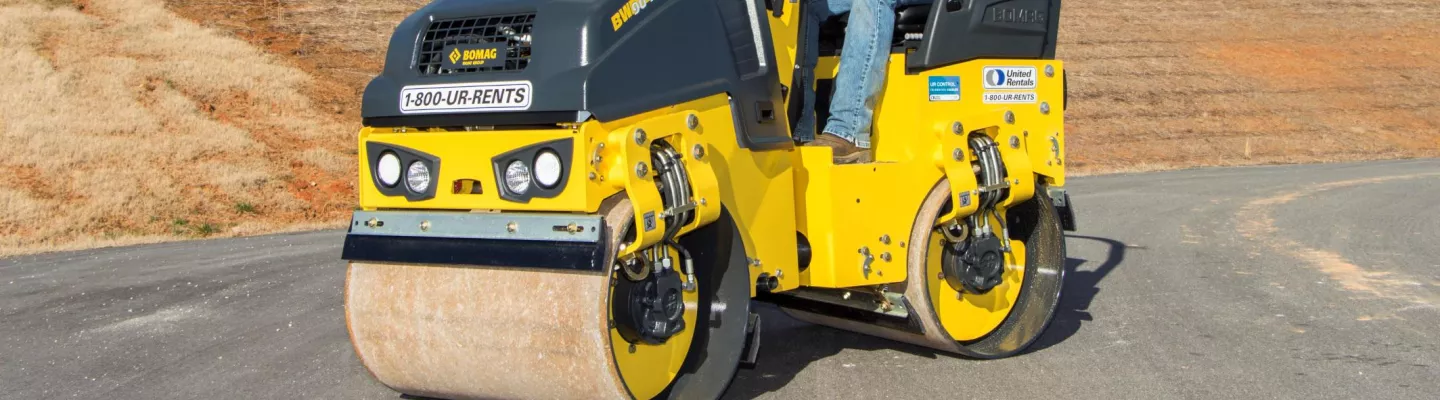
Lay the foundation for a quality result by learning which compaction equipment to use for your project.
Article Updated on: November 12, 2026
Whether you’re backfilling a trench, paving a road, putting in a walkway or executing foundation work, you’ll need the right piece of compaction equipment to do the job well and prevent erosion, flooding and instability. Discover three popular compaction equipment options and their applications and benefits.
Which compaction equipment is right for your project?
Equipment | Best Used For | Soil/Material Type | Common Applications |
|---|---|---|---|
Ride-on drum roller | Large areas | Granular soils, asphalt or gravel | Roads, parking lots and construction sites |
Walk-behind drum roller | Narrow work areas | Granular or cohesive soils | Shoulders, sidewalks, trenches, driveways, backfills and patching |
Rammer | Deep, precise compaction | Moist, cohesive soils | Trenches, pipe surrounds and foundation edges |
Vibratory plate compactor | Wider, open jobs | Granular soils | Driveways, patios and top layers of trenches |
What are drum rollers?
Drum rollers, also known as gravel rollers, are heavy-duty compaction machines that use large, heavy steel cylinders to flatten soil, gravel, concrete or asphalt. Drum rollers are available in ride-on and walk-behind models and can have single, double, smooth or padfoot drums.
Ride-on drum rollers vs. walk-behind drum rollers
Ride-on rollers are used to compact large areas and work well for:
- Roads
- Parking lots
- Whole construction sites
Walk-behind rollers are similar to ride-on rollers but are operated from behind. They’re designed to be used in narrow work areas and are convenient for:
- Shoulders, sidewalks and bike paths
- Trenches
- Driveways
- Backfills
- Patching
Single-drum rollers vs. double-drum rollers
The size and type of project will determine whether a single-drum or double-drum roller is best.
- Have less traction because they lack wheels and roll on the drums only
- Are better for relatively simple, flat jobs, such as compressing asphalt on a road
- Have wheels in addition to a drum, which gives them better maneuverability and traction
- Are suitable for a wider variety of jobsites
Smooth drum rollers vs. padfoot drum rollers
- Used for granular soils like sand, gravel or asphalt
- Have a flat, smooth-surfaced drum
- Used in road construction, site preparation and excavations
- Used for cohesive soils like silt or clay
- Has multiple protrusions, or “feet,” built in that knead the soil, wringing air and moisture out of it for faster, better compaction
- Used in utility of pipeline trenches, reinstatement jobs or on construction sites
What are rammers?
Rammers, also called jumping jack rammers, work the soil in two ways: They use impact and vibration, delivering thousands of pounds of force. They work well if you need to deeply compact soil, or you’re working with thicker layers of soil and need a compactor that can penetrate greater depths. Rammers should be used on moist, cohesive soils. They can also be used to compress patches of asphalt.
Rammers are smaller than other compaction equipment, so they’re perfect for small spaces, such as trenches, where other compaction equipment may not fit. They’re also used for more precise work, such as compacting around pipes or a foundation.
What are vibratory plate compactors?
Plate compactors use vibration to compact soil by bringing the soil particles closer together. They are designed to compact granular soil like sand, not cohesive soil. Since plate compactors are generally wider and easier to use than rammers, they can be used on bigger jobs, like driveways.
Oftentimes, a job will require both a rammer and a plate compactor. In trenches with cohesive soil, a rammer can be used to compress earth within the trench, and a plate compactor can be used on the top layer of more granular soil.
 Facebook
 X
 Linkedin
 Email
 Print
 Copy Link
 RSS Feed
